

Why AI Is the Secret Weapon
in the SaaS Iron Triangle
How many times have you stared at your roadmap wondering whether to ship fast, ship complete, or ship within budget, knowing you can only pick two? It’s the unsolvable riddle every SaaS CEO learns to hate. Your engineers want perfection. Your sales team wants features yesterday. Meanwhile, your CFO is peppering Slack with “Quick question about next quarter’s burn rate…” Welcome to the SaaS Iron Triangle. It’s the eternal tension between scope, time, and cost that shapes every critical product and strategy decision. In traditional project management, it sounds simple. In the SaaS world, it’s a living paradox. Between DevOps cycles, customer churn pressure, and “just one more feature” requests, the triangle is less a framework and more a high-stakes balancing act disguised as structure.
Let’s unpack why balancing the SaaS Iron Triangle is less about project management—and more about strategic survival.
Why the SaaS Iron Triangle Keeps Shifting
In old-school software, “done” meant done. You shipped a release, poured the champagne, and called it a milestone. In SaaS, “done” means tomorrow’s sprint demo, and a half dozen new Jira tickets born minutes later.
Continuous delivery has erased stable finish lines. Combine that with investors pushing for hypergrowth, customers expecting weekly improvements, and competitors launching on social media before QA finishes testing—and suddenly, every triangle decision feels like pulling the wrong Jenga block.
Three major forces make the SaaS Iron Triangle uniquely tough:
Infinite Scope Creep
Customers always want more. Competitors set new benchmarks. Your roadmap balloons until it looks like fine print.
Technical Debt as Compound Interest
Every hack and shortcut carries recurring costs—slow velocity, fragile architecture, and developer stress.
Stakeholder Chaos
Engineering wants stability, sales wants ammo, marketing wants differentiation, and investors want efficiency. No one’s wrong, but they can’t all win simultaneously.
Managing this is more than project scope…it’s about valuation, retention, and long-term scalability.
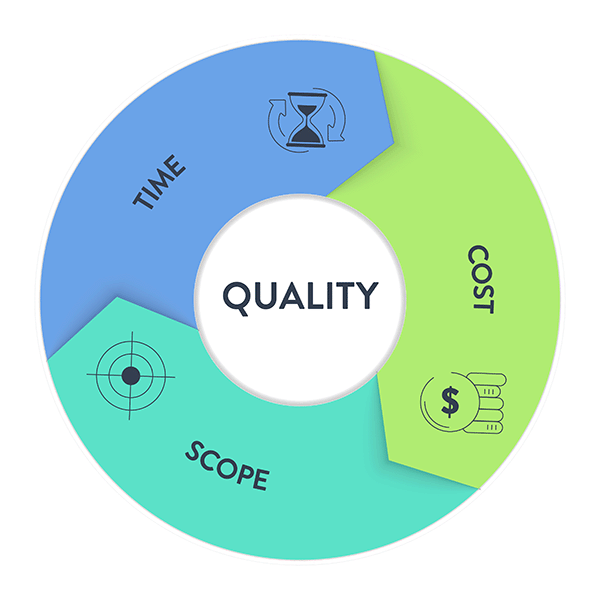
Real-World Tradeoffs in the SaaS Iron Triangle
Speed Over Scope
A large ecommerce company raced to switch to a new credit card processor. They hit the deadline, but cut features and QA corners. Short-term win, long-term tech debt.
Scope Over Time
A startup polished its MVP for eight months. Perfection came too late — another system went live first and captured a big segment of market share.
Cost Over Speed
A bootstrapped SaaS company streamlined features, reduced burn rate, and quietly endured. A couple of years later, they remained profitable while VC-backed rivals folded.
Each choice can work, depending on stage, market, and runway. The real skill isn’t in picking a corner—it’s in knowing when to stretch which side without snapping the rest.
How AI Rewrites the SaaS Iron Triangle
For modern SaaS teams, AI is changing how tradeoffs are analyzed and made. The new playbook favors simulation before decision. Imagine an intelligence layer across your product stack, surfacing predictive insights like:
- Customer Impact Prediction: Forecast retention lift from planned features versus vanity ones.
- Technical Debt Assessment: Quantify velocity drag or system fragility caused by shortcuts today.
- Market Timing Intelligence: Track competitor launches and demand shifts before your next sprint.
- Resource Optimization Modeling: Simulate how staffing, burn, and speed evolve under multiple scenarios.
By plugging this into tools like Jira, Linear, Productboard, or Amplitude, SaaS leaders can visualize the triangle before it breaks. Companies that adopt AI-driven decision intelligence report 30–50% faster decisions, tighter alignment across teams, and fewer “we should’ve seen that coming” moments.
AI doesn’t eliminate the SaaS Iron Triangle. It makes it transparent enough to navigate with confidence.
From Gut Instinct to Strategic Clarity
No SaaS CEO escapes the Iron Triangle. But those who thrive learn to orchestrate it. When every tradeoff is measured, you move from reactive to proactive. The next time your team debates shipping speed vs. feature depth, ask:
- What do retention and churn data suggest?
- Which path minimizes long-term technical debt?
- How does this align with our market cycle and runway?
The answers now exist in your stack—not your gut. That’s how you turn chaos into clarity and pressure into precision.
From Gut Decisions to Strategic Confidence
You’ll never escape the triangle…but you can stop being trapped by it. The best SaaS CEOs know their job is to orchestrate tradeoffs. When you can quantify the impact of every choice, you shift from firefighting to foresight. The next time your team argues scope versus shipping speed, ask:
- What does the data tell us about retention risk?
- Which decision minimizes long-term technical debt?
- How does this align with our current runway and position in the market?
The tools exist today to answer those questions clearly. That’s the real superpower: turning gut instincts into data-backed conviction.
Leave A Comment